

Beyond Hubble: The Ultimate Time Machine
Our understanding of the universe depends entirely on our instruments. Four centuries ago, telescopes revealed unsuspected moons and planets. Mid-20th century radio telescopes showed galaxies bursting with energy. The Hubble Space Telescope pierced time itself, photographing stellar nurseries and proving galaxies collide.
Now, James Webb stands ready to step beyond Earth and make observations possible only in the cold darkness beyond the moon.
Launched December 22, 2021, from French Guiana, Webb represents an international collaboration between NASA, ESA, and the Canadian Space Agency. Its mission: answer astronomy’s most ambitious questions while granting glimpses of sights never before seen—from galaxy births to light from the very first stars.
Standing on Giants’ Shoulders
Webb builds upon NASA’s Great Observatories—four remarkable space telescopes covering the electromagnetic spectrum. Hubble pioneered visible-light observation starting in 1990, becoming one of the most productive scientific instruments ever built. The Compton Gamma Ray Observatory (1991-2000) detected violent cosmic spectacles. Chandra (1999-present) monitors black holes and high-temperature gases. Spitzer (2003-2020) observed in thermal infrared, revealing star births and galactic centers.
Webb’s revolutionary capability? Deep near- and mid-infrared observation with four science instruments capturing images and spectra simultaneously.
Why Infrared Matters
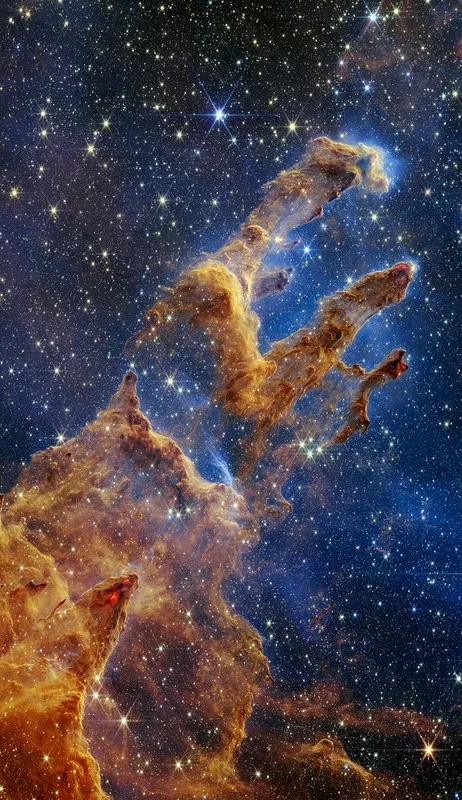
Stars and planets forming behind dust clouds absorb visible light. Infrared pierces that blanket. Scientists will observe the universe’s very first stars; infant galaxies forming and colliding; and the birth of stars and protoplanetary systems—possibly containing life’s chemical building blocks.
Those first stars hold keys to understanding cosmic structure. Their formation relates to early dark matter patterns, and their explosive deaths as supernovae created black holes that merged into the massive singularities occupying most galaxy centers.
No instrument built before Webb could witness any of this.
Engineering Marvel: The Design
Webb resembles a diamond-shaped raft with a curved mast and sail—if giant beryllium-chewing honeybees built it. The “raft” is a sunshield made of five Kapton membrane layers (each thin as human hair) coated with reflective metal, protecting the main reflector and instruments.
Above sits the “sail”—Webb’s giant primary mirror spanning 21.4 feet (6.5 meters), triple Hubble’s 7.8-foot mirror. It comprises 18 hexagonal beryllium segments that unfold after launch, then coordinate as one massive mirror. This design allows the entire structure to fold like a drop-leaf table. Hexagonal shapes enable roughly circular configuration without gaps.
The mirrors are covered in microscopically thin gold layers optimized for reflecting infrared—Webb’s primary observation wavelength.
The Instruments: Seeing the Invisible
Near Infrared Camera (NIRCam) – Detects 0.6-5.0 micron range infrared from earliest stars/galaxies; takes census of nearby galaxies; spots Kuiper Belt objects. Includes coronagraph to block star glare for exoplanet detection.
Near Infrared Spectrograph (NIRSpec) – Analyzes physical characteristics by splitting light into spectra revealing temperature, mass, and chemical makeup. Features 62,000 individual shutters enabling simultaneous observation of 100 objects—the first space-based spectrograph with this capability.
Fine Guidance Sensor/Near Infrared Imager and Slitless Spectrograph (FGS-NIRISS) – Two sensors examining first light detection, exoplanet characterization, and transit spectroscopy while helping point the telescope.
Mid-Infrared Instrument (MIRI) – Camera and spectrograph covering 5-28 microns, picking up planets, comets, asteroids, and protoplanetary disks. Its wide-field broadband camera snaps Hubble-style images.
Four Mission Objectives
- First Light and Reionization – Webb will “see” back 100-250 million years after the Big Bang when first stars/galaxies formed. Questions: What were the first galaxies? When did reionization occur? What sources caused it?
- Galaxy Assembly – Webb will observe faintest, earliest galaxies and massive spirals. How do galaxies evolve over billions of years? What’s the relationship between black holes and host galaxies? How are chemical elements distributed?
- Star and Planetary System Birth – Unlike Hubble, Webb sees through dust clouds where stars form by detecting infrared heat. Questions: How do gas/dust clouds collapse into stars? Why do most stars form in groups? How do planetary systems form?
- Planetary Systems and Life’s Origins – Studies exoplanets and our solar system’s small bodies (asteroids, comets, Kuiper Belt objects). How are planetary building blocks assembled? How did life develop on Earth? Was there ever life on Mars?
The Hidden Universe Revealed
As the universe expands and galaxies move apart, their light stretches and becomes “redshifted”—sliding toward longer wavelengths like infrared. The farther away the galaxy, the faster it recedes and the more redshifted its light.
Infrared spectra also reveal exoplanet atmospheres—and whether they contain molecular life ingredients. Water vapor, methane, and carbon dioxide absorb thermal infrared everywhere in the universe. Webb will detect these substances by looking for telltale absorption patterns in spectroscopic readings.
Mission Timeline
Expected mission duration: 5-10 years. The data Webb provides could fundamentally change our understanding of the universe by examining all phases of cosmic history from the Big Bang forward.
Webb represents humanity’s most sophisticated attempt to answer existence’s deepest questions: Where did we come from? Are we alone? What happens next?