A Trillion-Dollar Opportunity
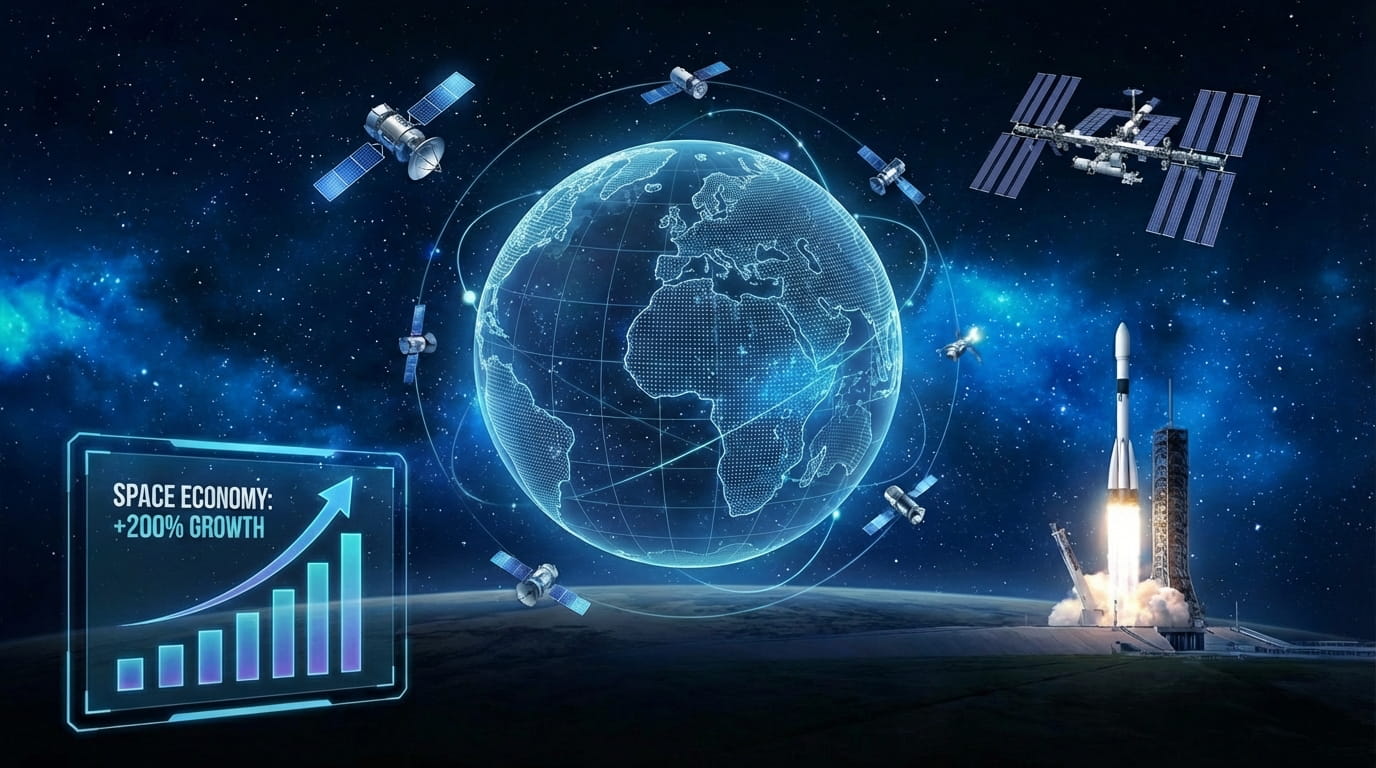
The space economy is projected to surpass $1.8 trillion, with over 60,000 satellites expected in orbit by 2030. Companies across all industries can enhance their processes, efficiency, and resilience through space-based technologies and data.
Space-based technologies—products and services that utilize signals and data from satellites—are generating unprecedented insights into global conditions and markets. These rapidly growing opportunities are transforming business operations across all industries, helping companies grow and build resilience in the process.
The Integration Gap
Despite the enormous potential, there’s a significant gap between recognition and action. Over 80% of executives view space-based technologies as crucial for revenue growth and differentiation, yet only 18% have integrated them into daily operations.
This represents a massive opportunity for companies willing to move beyond exploration into implementation.
Transforming Industries Through Satellite Technology
Satellites are revolutionizing industries like agriculture, resources, retail, and financial services by providing unique capabilities such as uninterrupted broadband communication, real-time asset tracking, and emissions monitoring. These developments help organizations strengthen supply chains and reduce inventory, among other benefits.
Real-World Applications
Executives are already discovering the remarkable possibilities that space-based technologies offer for IT infrastructure, research and development, customer service, and supply chain management, among other functions.
Here are some practical examples:
Energy Sector: One electric and natural gas utility company is using satellite imagery to detect and address methane leaks in its networks. This enables much faster repair times and helps the company meet its emissions reduction targets.
Environmental Conservation: A biodiversity firm uses satellite imaging and AI to detect and manage invasive plants, supporting conservation through early detection and efficient control.
Transportation: A railway company has been integrating Low Earth Orbit (LEO) Satellite Connectivity, transforming passenger experiences while building resilience into their operations.
Logistics: A logistics company can use multiple satellite-enabled capabilities such as electro-optical (EO) imagery combined with weather data and GPS tracking to monitor and predict the travel times of cargo ships.
Overcoming Barriers to Adoption
Despite widespread recognition of these opportunities, many companies remain in the early stages of integration. The most common barriers are perceived high costs, a lack of suitably skilled talent, and the absence of the right technology infrastructure. These concerns are valid but not insurmountable.
Three Steps to Unlock Space-Based Potential
- Build Strategic Vision
Companies need to develop a clear understanding of how space-based technologies align with their business objectives and create value across their operations.
- Develop the Right Talent
While space-specific skills and knowledge are important, making the most of the new flows of data and insights that space-based technologies provide also requires data, analytics, and AI talent.
- Activate Partner Ecosystems
Activate an ecosystem of partners to help with developing and accessing required skills and infrastructure as well as sharing the costs of participating in the space economy.
The space ecosystem is complex and constantly evolving, with more than 3,000 companies driving the space economy. More than 80% of executives believe that partnerships with space-based technology application developers, space agencies, and satellite manufacturers are essential for their company’s growth.
The Power of Partnerships
Partnerships can provide access to cutting-edge technologies and expertise that might be out of reach for a single company.
Consider this example: a renewable energy company partners with a space technology firm to develop a cloud platform that ingests highly precise earth surface data from satellites. This platform uses AI and analytics to identify and monitor methane emissions, enabling the company to take actions to reduce its environmental impact and enhance operational resilience. By working together, the company and its partners can achieve outcomes that would be impossible to achieve alone.
The Competitive Advantage
The potential applications are endless, and the benefits are clear: enhanced decision-making, improved operational efficiency, and the creation of new revenue streams.
Integrating with the large and growing space economy, can provide the edge companies need to outmaneuver the competition both now and for years to come. With a clear strategic vision, access to the right talent, and an ecosystem of relevant partners, every company in every industry can overcome the challenges to using space-based assets and insights to transform operations for greater growth, resilience, and value.